



Bodmin Riding & Heritage Festival
For one weekend each year, the ancient county town of Bodmin throws open its streets to a festival so old that even its origins are lost to time – and so vivid that it stops traffic, draws crowds, and conjures a medieval atmosphere like almost nothing else in the south-west.
Bodmin Riding & Heritage Festival takes place on the first weekend of July, and in 2026 that means the festivities kick off on Friday 3 July, with the heart of the celebration on Saturday 4 July.
A tradition older than memory
The earliest written record of Bodmin Riding dates to 1469, when it appeared in the accounts for the rebuilding of Bodmin Parish Church. But even then, it was described as an established custom, suggesting its roots stretch back further still, possibly into the early medieval period.
At its heart, the festival commemorates one of the more dramatic episodes in Bodmin’s long history: the theft of the bones of St Petroc in 1177, when the relics of the town’s patron saint were spirited away to Brittany, before being recovered and triumphantly returned. The procession of St Petroc’s casket, which still survives in St Petroc’s Church, remains a central element of the festival to this day.
Nobody knows when or why Bodmin Riding began. It was an ancient event in 1469 — the first time it was recorded on paper.
Over the centuries, the festival grew to include sports and horseracing, Cornish wrestling, a grand ball, civic feasting, and the Riding Ale – a tradition of communal drinking that remains part of the weekend. The custom faded in the early 19th century, with the last traditional Riding thought to have been held around 1825 but was revived in 1974 and has since developed into the lively event it is today.
 What happens on the day
The weekend begins on the Friday evening with a shared feast – local food and drink, live music, and the ritual Riding Ale, gathering the community in anticipation of the celebrations ahead. On Saturday, the town centre closes to traffic and the streets come alive.
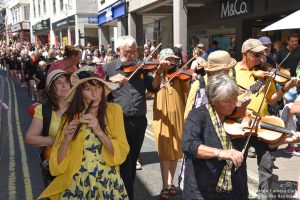
The traditional procession is one of the day’s highlights: led by Bodmin Town Band, with local children performing the furry dance to the centuries-old Riding Tune – a melody first recorded in 1770 under the title Captain Brown’s March.
Attendees are encouraged to come in medieval costume, and many do, lending the streets a fun and chaotic atmosphere. Alongside the procession, you’ll find craft stalls, local artisans and businesses, historical re-enactments, live music, and plenty of children’s activities. It’s a full day out for families and history enthusiasts alike.
Hunt for the Beast
No account of the Bodmin Riding festival is complete without mention of its most theatrical element – the Hunting and Trial of the Beast of Bodmin. The Beast, depicted as a large, shaggy, panther-like creature, is pursued through the town by hunters known as “helliers”, before being dramatically captured and put on trial outside the historic Shire Hall.
The Beast tradition links to real-life folklore – in the 1980s and 1990s, Bodmin Moor was the site of numerous reported sightings of a large wild cat, and the legend has never quite gone away. The festival’s mock trial gives it a suitably Cornish twist, part street theatre, part ancient ritual, and very memorable.
A celebration of Cornish identity
Beyond the spectacle, Bodmin Riding is something rarer – a genuinely community-owned festival, run by local volunteers and shaped by local people. It commemorates not just the bones of St Petroc, but also the Cornish Prayer Book Rebellion of 1549 – when Cornish men and women took up arms to defend their language and religious traditions – and the hanging of Mayor Nicholas Bowyer, a figure woven into the town’s civic memory.
Like Padstow’s famous May Day celebrations, Bodmin Riding is a reminder that Cornwall has a living tradition of festival culture stretching back centuries – one that belongs to the people who take part in it.
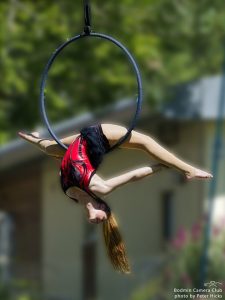
With thanks to the Bodmin Camera Club for the images from the 2019 festival.