



Bodmin Wells
Stroll Bodmin’s streets in search of ancient wells, priories and pilgrims.
Heritage | Approx. 1 hour
Suitable for: walkers, cyclists and older families.
This is a fairly long walk, with an occasional distance between stops, so we recommend an unhurried approach: take your time, be curious, and look around. We’ve suggested optional pause points for rest and refreshments.
-
Bodmin’s highways, byways and buildings reveal more than you might expect. Before the Dissolution of the Monasteries in the 1500s, this landscape was alive with religious activity. The town we see now was a thriving heartland of churches, chapels, hospitals, and religious houses.
Time has passed, but their traces remain. Look a little deeper and you’ll spot fragments and footprints of this magnificent age. From the holy wells that first attracted settlers to the buildings that topped them, these centuries-old survivors still have a lot to tell us.
Start in Priory Park, near the football ground and pump track
-

Start
1. St Petroc’s Well
Where the stream flows, seek out St Petroc’s Well. A simple door once kept out curious eyes, but today, it’s open to the water that floods inside. We think this site was originally part of the grounds of Bodmin Priory, dating back to the 6th century. With lands stretching all the way from Portreath to Tintagel, and inland towards, Lanhydrock, the monastic order was one of Bodmin’s major early landowners.
The well and its waters are ancient, but the granite building above came centuries after, around the 1600s. An interesting clue from this time was later discovered tucked inside: a wooden statue of St Mary, safely hidden from Oliver Cromwell’s Civil War troops for many years. Today, it stands restored, painted and protected at Buckfast Abbey in Devon.
When you're ready...
Your next stopping point is St Petroc’s Church. Head out of the park, passing the pond, and on to Priory Road. Make your way to the church steps near the roundabout, and pause at the bottom to find St Guron’s Well.
-

2. St Guron’s Well and Well House
St Guron’s Well
This well first appears in the 12th century “Life of St Petroc”. The church you see now was probably built over the original well site: Bodmin’s 16th century churchwardens recorded work on aqueducts beneath the building. These carried the natural spring water through the church and out into the churchyard.
Today, this water runs into granite troughs and spouts from the mouths of two gargoyles (to spot the difference, one has horns and the other has pendant ears). The date above is 1545, but this site is probably much older, and served as the town’s main water supply well into Victorian times. So, for everyone from roaming pilgrims to hard-working families, it’s been a vital gathering point for generations.
Up the steps, you’ll find the well house. If you’d prefer level access, continue along the pavement, passing the front of the church, until you see another path leading in.
The Well House
Although the church towers over it, this humble building protects something precious. This is the “home” or starting point of the sacred spring – the place where its journey begins. Made from rough granite slabs, it was probably added around 1545.
The waters here are dedicated to St Guron, one of Bodmin’s earliest founders. He was here first, but when St Petroc later arrived to set up a vast monastery, Guron moved out towards the coast. There, we now find the village of Gorran Haven.
When you're ready...
Make your way back down to St Guron’s Well, pass the steps (going left, if facing the church), and follow the road around to the Dennison Road car park. You’re looking for the Eye Well, which is next to the alleyways leading into the town centre.
-
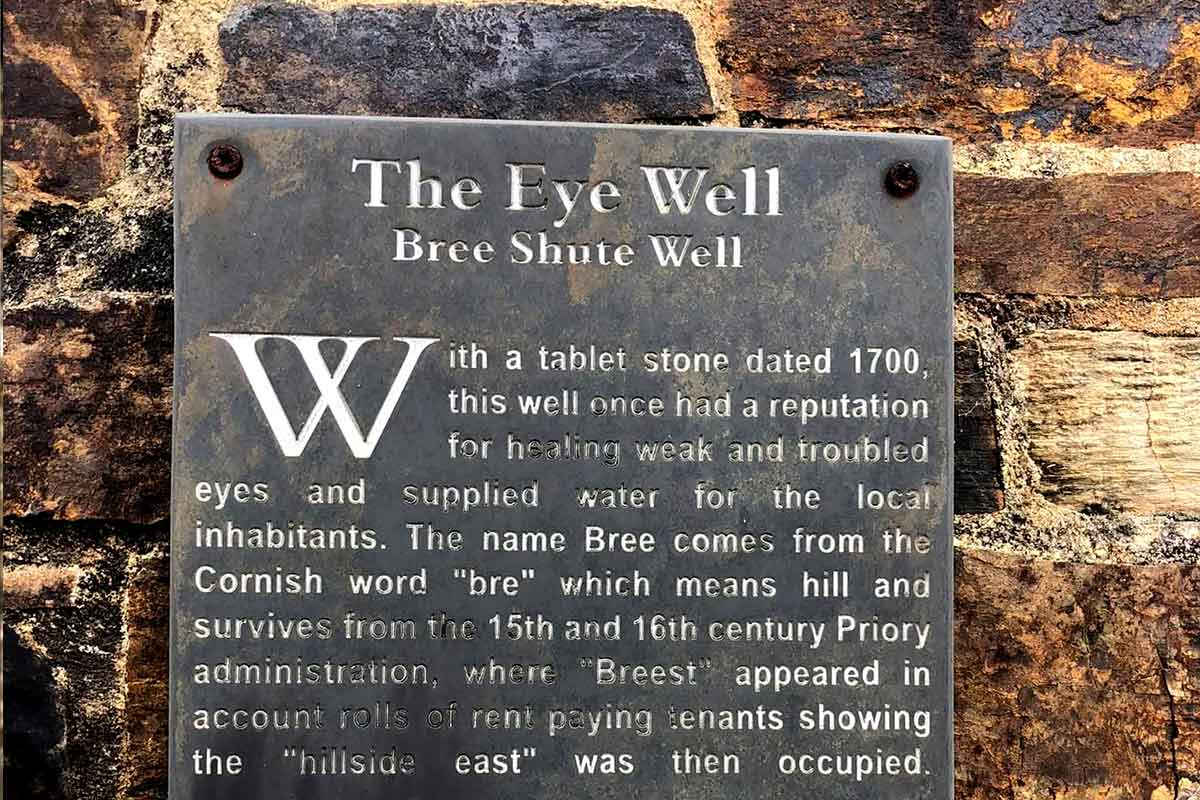
3. The Eye Well (or Bree Shute Well)
The Eye Well’s secret lies in its name. Years ago, people were drawn here by the water’s reputation for healing eyes. But, for those who lived nearby, it had more everyday value as a handy water supply.
This was a mixed blessing – during the 19th century, deadly fevers bubbled up each year, claiming the lives of local residents. In 1872, the well’s water was inspected and recorded as “fairly good”. Despite this loose definition, analysis actually showed that it was highly contaminated and probably carried fatal illnesses.
When you're ready...
If you’d like a rest stop, you’ll find benches in the Dennison Road car park. Nearby passages like Bell Lane and Bree Shute Lane lead to Fore Street, where you can also grab a hot drink or quick bite to eat in one of Bodmin’s cafes.
When you’re keen to carry on, go to the corner of Chapel Lane and Dennison Road to discover Cock’s Well.
-
4. Cock’s Well
Dated to 1849, Cock’s Well supplied water for local residents, and for the blacksmith’s shop that once stood opposite. But taking a drink here could be dangerous. In 1881, an outbreak of enteric fever – an illness similar to typhoid – was traced back to infected waters from this well. Among the 13 victims were two blacksmiths who, because of their hot work, drank large amounts of water.
When you're ready...
Cross the road and walk along Berrycombe Road (to the right of Burnards Court). Stop when you reach the fork in the road, which leads onto Bodmin Jail.
-
5. Berrycombe Cross
This wheel-headed cross now stands in the long shadow of the jail, but during the medieval period, many wayside crosses like this existed. Set along religious routes, they were used to reassure weary travellers and point them on their way.
For many years, this cross lay discarded on top of a heap of stones, but in the late-1800s, the jail’s governor, Captain Nonvay, had it re-erected. The reason for its location has been debated over time. It may have marked the boundary between Bodmin and the “next door” manor of Bodiniel. Or, it might have been a sign to pilgrims travelling on to Scarlett’s Well; a welcome wink that they were on the right path.
When you're ready...
Follow the ancient pilgrims and venture out to Scarletts Well (the optional point 6 on our trail).
Go further...
Because it’s little further out of town, Scarletts Well is a longer walk, but well worth a visit. Head in the direction of the Camel Trail, and when you reach the car park, go down the metalled lane into the woods. If your legs need a rest, you’ll find welcome benches in the car park.
-
Finish
6. Scarletts Well
It may appear humble, but this was the most renowned of Bodmin’s holy wells. Named after the wealthy Scarlett family, it probably belonged to the Priory of Bodiniel. As holy wells grew in popularity, news spread that the spring here was responsible for “healing all diseases”. To control the sudden crowds of flocking visitors, the justices of the town cordoned off the spring – stopping its use.
When you’re ready…
You’ve completed the trail: retrace your steps, passing the Berrycombe Cross, to return to the town centre.


