
Bodmin’s food and drink scene has been quietly building something special over the last few years. From award-winning pubs and Michelin-recognised dining to independent cafés, local producers and lively street food events, the town is becoming a place where great food feels rooted in community, creativity and Cornwall itself.
At the heart of it all is a strong sense of local pride. You’ll find chefs championing Cornish produce, family-run cafés bringing flavours from around the world to the town centre, and producers supplying restaurants and retailers across the UK.
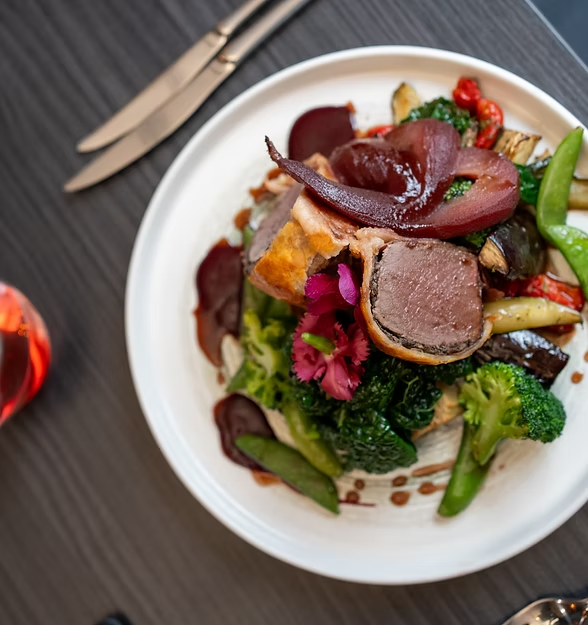
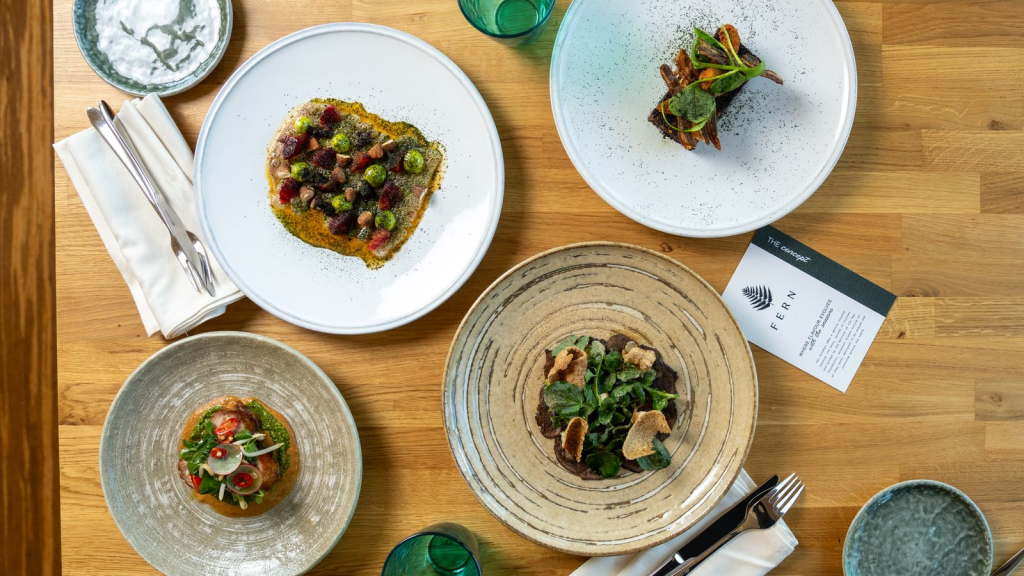
One of the clearest signs of Bodmin’s growing reputation is the success of Fern Cornwall, just outside the town in nearby Nanstallon. Led by Michelin-trained chef Paul Welburn, the restaurant has earned recognition from the MICHELIN Guide for its modern approach to Cornish dining and focus on seasonal local ingredients. Bodmin’s independent restaurant scene continues to gather momentum too.
Flory Restaurant recently celebrated a double awards success, picking up both a Tripadvisor Travellers’ Choice Award and a Gold Award at the Taste of the West Awards, recognising its commitment to showcasing West Country produce.
The town’s pubs are also gaining national attention. The Hole in the Wall has long been one of Bodmin’s best-loved historic pubs, and in 2025 it was named CAMRA South West Pub of the Year -putting it amongst the top real ale pubs in the country.
Tucked away in The Piazza, you’ll find Native Burger, one of Bodmin’s most popular restaurants. Serving mouth-watering burgers made using local produce, they are winners of both regional and national best casual dining at the 2025 Muddy Awards.
Alongside these destination venues, Bodmin’s food culture is equally shaped by its independent cafés and everyday gathering places. The town has seen a growing number of Portuguese cafés and bakeries bringing fresh pastries, strong coffee and relaxed continental-style hospitality to Cornwall. New openings have quickly built loyal followings, adding another layer to Bodmin’s increasingly varied food scene.
Community events are helping bring everything together. Bodmin Feast – Street Food Evenings have become regular fixtures in the town calendar, filling Mount Folly with food traders, music and people gathering in the centre of town on Friday evenings. Organisers describe the events as a way to bring “great local food, community spirit, and a bit of buzz” into Bodmin.
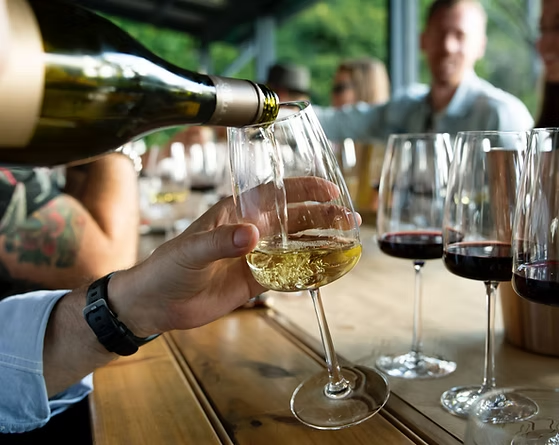
The wider food and drink economy around Bodmin is just as important to the story. Businesses including Proper Cornish, The Cornish Company Suppliers, Harbour Brewing Co. and Camel Valley Vineyard are all helping put this part of Cornwall on the culinary map, producing and supplying food and drink enjoyed far beyond the county.
And there’s more to come. Food festivals, pop-ups and independent openings continue to grow, while events like eat:Bodmin Food Festival are helping showcase local producers and bring new visitors into the town.
Whether it’s a pint in a centuries-old pub, street food on Mount Folly, coffee and pastel de nata in a tucked-away café, or a Michelin-recognised meal in the countryside nearby, Bodmin’s food and drink scene is becoming one of the town’s most exciting stories.
With thanks to Harbour Brewery, Flory and Fern Cornwall for the photos featured in this article.



In every rainy day – whether it’s damp Cornish drizzle or a heavy downpour – there’s an invitation to change course, step inside and seek shelter. Wet weather can be a prompt to discover something new.
Spring is famous for its showers, but even the summer months can bring their share of sweeping dark clouds. In Bodmin, there’s no reason for rain to stop play. From stately homes to live shows, there’s always an undercover adventure to find.
Atmospheric attractions
New experiences aren’t only found in the great outdoors – our local attractions are steeped in atmosphere. Step inside Bodmin Jail, where tall stone walls and jail cells have tales to tell. Here, you can capture the eerie thrill of histories that unfold “behind bars”. Or journey into the countryside while staying safely under cover, courtesy of Bodmin Railway. A ride in a vintage carriage gives you a window onto 13 miles of scenery, with the added magic of steam power.
Historic houses
When the forecast looks mixed, take a trip to one of Bodmin’s historic estates. Both Lanhydrock and Pencarrow have vast gardens to explore during dry spells, as well as woodland areas for shelter during showers. And, if rain sets in – or even if it doesn’t – you can head inside to explore their grand houses. Both estates have cafés serving cream teas, cakes and lunches, while Lanhydrock also has a second-hand bookshop for a leisurely browse.
Performances and screenings
If the weather outside is gloomy, escape to another world for an hour or two. Bodmin’s Capitol Cinema on Mount Folly Square shows a mix of recent releases and stage-to-screen productions. Or tap into stories, song or dance at a live performance. Found in the heart of town, the BEAT offers a packed programme of shows, with other events held at The Old Library, St Petroc’s Church, and local community venues.
Discovery hotspots
A day spent indoors can lead to a wealth of fresh discoveries. With more time to spare, immerse yourself in places that provoke curiosity. At Bodmin Town Museum, a wander among the collections takes you deep into the lives of generations past. Not far away, at Bodmin Keep, exploration takes a military turn, with 300 years of army history in one place. And, at Discovering42, you can stretch your imagination and understanding as you get hands-on with interactive art and science exhibits.
Good to know…
Some local attractions adopt winter opening hours, or close during the quietest months of the year. We’d always recommend checking ahead, before setting off.
Bodmin’s Beacon is a natural haven for all – from adventuring families to native wildlife. Local residents have walked, talked and played here for at least 200 years. This granite-studded ground has hosted Cornish wrestling tournaments and wartime armies, but today the atmosphere is more tranquil. Now a nature reserve, it’s carefully tended to encourage a huge range of settled species.
Across the Beacon’s 87 acres, there’s a rich diversity of areas. You’ll find woodland, heathland and wildlife meadows, as well as a picnic field and “bird delis”: fields especially planted with crops to feed birds throughout the year. While exploring, you might also come across Bodmin’s community woodland, populated with 30,000 trees. Or, head up to the monument and marvel at its spectacular views.
Each season breathes new life and interest – dormant wildlife wakes and plant species spring into action. So, while you’re here, see what you can spot.
In spring and summer, birdsong provides the soundtrack, with many different species stopping by. An abundance of wildflowers tempts bees and butterflies, while thriving insect numbers support resident bat colonies. And, throughout the year, you’ll see pops of colour, courtesy of the Beacon’s plant life; from pink butterfly fungi and purple heather to bright yellow gorse.
Planning a visit? We’ve collected the key details to help you plan ahead.
From Fore Street car park, you can cut through the Burgage Plots. Walk along Meadow Place, up Beacon Hill and Robartes Road, and past Beacon Academy. Cross the road onto Beacon Road, and walk up to the car park entrance.
With so many routes to explore, dogs are guaranteed a good time at the Beacon. But, because there’s so much wildlife at home here, we suggest keeping them on short leads near any farm animals or nesting birds.
The reserve features graveled and tarmacked paths, but some of its most intriguing hidden corners are off the beaten track. Depending on the season, some sections can be muddy underfoot, so it’s best to be prepared with practical footwear.
One town centre – with so much to do, see and discover. So, where to start? Here, we share some of our favourite sights and stopping points.
Bodmin is a town of character and care. Its streets tell stories that stretch back centuries – from ancient landscapes to an imposing Victorian jail – while a thriving community of independent shops, cafés, and creative spaces lend it a warm, welcoming feel. Whether you’re drawn to history, invigorated by nature, or simply soaking up life in a Cornish community, there’s plenty here to fill your time.
We’ve gathered some of the top things to do in Bodmin’s thriving town centre, whether you have an hour or two to spare or a while to settle in…
Our town centre is a real treasure trove. If you’re able to stay awhile, there’s ample opportunity to explore what Bodmin has to offer.
Step back in time at Bodmin Town Museum
Pull at the threads of Bodmin’s past at the Town Museum, where local history comes to life. From ancient artifacts to Victorian treasures, the museum offers a fascinating glimpse into the town’s centuries-long evolution. Allow yourself an hour or two to wander through the displays at your leisure – you’ll find tales of Bodmin’s people, trades, and traditions waiting to be told.
The museum is located on Mount Folly Square, just across from the Shire Hall.
Coffee and a browse on Fore Street
Set within Bodmin’s grand old library are intoBodmin, a local arts organisation (which also runs workshops and walks), and The Old Library Café: a laid-back space in which to meet and eat. Pop along for coffee and cake or a lunchtime treat – or, on a sunny day, sit out in the café’s community garden. Afterwards, take your time wandering along Fore Street, where the shops are dotted with unexpected finds, from vintage treasures to handcrafted goods.
To visit The Old Library, stroll along Fore Street towards Lower Bore Street.
Walk up to Bodmin Beacon Nature Reserve
If you’ve time for a climb, the reward at the top is well worth the effort. The Gilbert Monument stands proudly on Bodmin Beacon, offering sweeping views across the Cornish countryside. Once you’ve caught your breath, venture into the Bodmin Beacon Nature Reserve – a beautiful area of heathland that’s home to butterflies, birds, and wildflowers. It’s a perfect escape into nature, all within easy reach of the town.
The footpath to Gilbert Monument begins on Berry Tower Hill, off Beacon Road.
Making a little more time creates the chance to wander further, do more, and look deeper. With a half-day ahead, you can slow down and soak in your surroundings.
Visit Bodmin Jail
Rich in atmosphere and old, eerie tales, Bodmin Jail takes visitors on a journey through 200 years of crime and punishment. Self-guided tours mean you can take things at your own pace (we suggest allowing around two hours), before heading to the Moor Café for a spot of lunch. Or opt for a guided tour, peeping into some of the jail’s darkest corners with an expert storyteller.
You’ll find Bodmin Jail on Berrycombe Road, an easy walk from Fore Street.
Journey on the Bodmin Railway
Pop from town to countryside in a surprisingly short time – a ride on Bodmin Railway transports you through some of the area’s most scenic spots. Spend an afternoon steaming along its historic railway line, pulled by a vintage engine. A circular ticket will take you from the nearby Bodmin General station, along two branch lines and back home again, with short stops on the way.
Your starting station for Bodmin Railway is a 10-15-minute walk from the town centre, on Harleigh Road.

Join a workshop at Bodmin Gallery & Creative Studio
Keen to try something different? At Bodmin Gallery & Creative Studio, you can stretch your skills in a welcoming, friendly environment. The studio runs a number of half-day and full-day workshops throughout the year – these vary depending on the season or series, so we suggest checking and booking in advance. Past and current sessions have included activities like willow weaving, nature drawing and silverwork.
Workshops are based at the gallery, on Bodmin’s Fore Street.
Get hands-on at Discovering42
Tap into the joy of discovery at Cornwall’s innovative (and award-winning) art, science and sustainability museum. Here, there’s every chance to get stuck in as you play, test and experiment. Fusing subjects like chemistry and physics with craft activities and environmental awareness, a visit will stretch your imagination in new and interesting ways.
For those carefree days when you’ve got time in hand, combine some of the above to curate a full day out. For instance, Bodmin Jail and Bodmin Railway are conveniently close together, creating a living history tour of the town. Or make lunch at The Old Library Café your reward for climbing the Beacon. However you mix and match, Bodmin will make the most of your time.
For one weekend each year, the ancient county town of Bodmin throws open its streets to a festival so old that even its origins are lost to time – and so vivid that it stops traffic, draws crowds, and conjures a medieval atmosphere like almost nothing else in the south-west.
Bodmin Riding & Heritage Festival takes place on the first weekend of July, and in 2026 that means the festivities kick off on Friday 3 July, with the heart of the celebration on Saturday 4 July.
The earliest written record of Bodmin Riding dates to 1469, when it appeared in the accounts for the rebuilding of Bodmin Parish Church. But even then, it was described as an established custom, suggesting its roots stretch back further still, possibly into the early medieval period.
At its heart, the festival commemorates one of the more dramatic episodes in Bodmin’s long history: the theft of the bones of St Petroc in 1177, when the relics of the town’s patron saint were spirited away to Brittany, before being recovered and triumphantly returned. The procession of St Petroc’s casket, which still survives in St Petroc’s Church, remains a central element of the festival to this day.
Nobody knows when or why Bodmin Riding began. It was an ancient event in 1469 — the first time it was recorded on paper.
Over the centuries, the festival grew to include sports and horseracing, Cornish wrestling, a grand ball, civic feasting, and the Riding Ale – a tradition of communal drinking that remains part of the weekend. The custom faded in the early 19th century, with the last traditional Riding thought to have been held around 1825 but was revived in 1974 and has since developed into the lively event it is today.
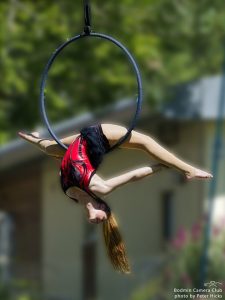
 What happens on the day
The weekend begins on the Friday evening with a shared feast – local food and drink, live music, and the ritual Riding Ale, gathering the community in anticipation of the celebrations ahead. On Saturday, the town centre closes to traffic and the streets come alive.
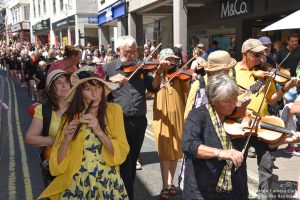
The traditional procession is one of the day’s highlights: led by Bodmin Town Band, with local children performing the furry dance to the centuries-old Riding Tune – a melody first recorded in 1770 under the title Captain Brown’s March.
Attendees are encouraged to come in medieval costume, and many do, lending the streets a fun and chaotic atmosphere. Alongside the procession, you’ll find craft stalls, local artisans and businesses, historical re-enactments, live music, and plenty of children’s activities. It’s a full day out for families and history enthusiasts alike.
No account of the Bodmin Riding festival is complete without mention of its most theatrical element – the Hunting and Trial of the Beast of Bodmin. The Beast, depicted as a large, shaggy, panther-like creature, is pursued through the town by hunters known as “helliers”, before being dramatically captured and put on trial outside the historic Shire Hall.
The Beast tradition links to real-life folklore – in the 1980s and 1990s, Bodmin Moor was the site of numerous reported sightings of a large wild cat, and the legend has never quite gone away. The festival’s mock trial gives it a suitably Cornish twist, part street theatre, part ancient ritual, and very memorable.
Beyond the spectacle, Bodmin Riding is something rarer – a genuinely community-owned festival, run by local volunteers and shaped by local people. It commemorates not just the bones of St Petroc, but also the Cornish Prayer Book Rebellion of 1549 – when Cornish men and women took up arms to defend their language and religious traditions – and the hanging of Mayor Nicholas Bowyer, a figure woven into the town’s civic memory.
Like Padstow’s famous May Day celebrations, Bodmin Riding is a reminder that Cornwall has a living tradition of festival culture stretching back centuries – one that belongs to the people who take part in it.
With thanks to the Bodmin Camera Club for the images from the 2019 festival.
Flamm, Cornwall’s contemporary art festival, will take place in Bodmin, Cornwall, in 2026 from Saturday 28th February to Sunday 1st March 2026.
Today, Flamm is delighted to announce the full programme, taking place across the town; showing work made by those living and working in Cornwall and the South West, many being supported by the festival to realise their ideas and create new works, as well as bringing global artists to the region for the first time, with partners including Liverpool Biennial and Counterpoints Arts.
Over 20 exhibitions, installations and events over the weekend will transform the Cornish town, from the platform of the heritage railway station to Bodmin Keep and Bodmin Jail, along the high street and paths of the town and in unexpected places.
Newly commissioned artists include:
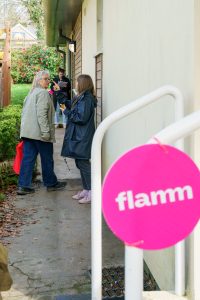
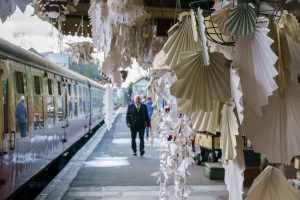 Nicola Bealing’s work spans painting, printmaking and installation. Drawing on historical narratives, folklore and everyday absurdities, she reimagines found stories with dark humour and psychological depth. For Nicola’s project, a forest of ghostly hanging baskets will transform the platform at Bodmin General into a surreal, unsettling landscape. Expanding the station’s usual eight baskets to around fifty, each will overflow with pale paper cut-outs of plants, animals and human forms. Suspended overhead, they will disrupt sightlines and movement, creating a playful yet disconcerting “glitch” in the everyday, where familiar station décor tips into something uncanny and unexpected.
Rachael Jones works between landscape, memory and human connection to place. Working with moving image, sound and installation, she often collaborates with communities to reveal layered local stories and overlooked voices. Her films balance poetic imagery with documentary sensitivity, creating intimate portraits of people and environments in flux. Rachael’s project reimagines hidden objects from Bodmin Keep’s archives while the museum undergoes repairs. Selected items will be reproduced as large weatherproof cut-outs, creating a trail around the site that leads to a film installation in the Keep’s trench. Drawing on diary entries from the collection, narrated by local voices, the film weaves personal and social histories.
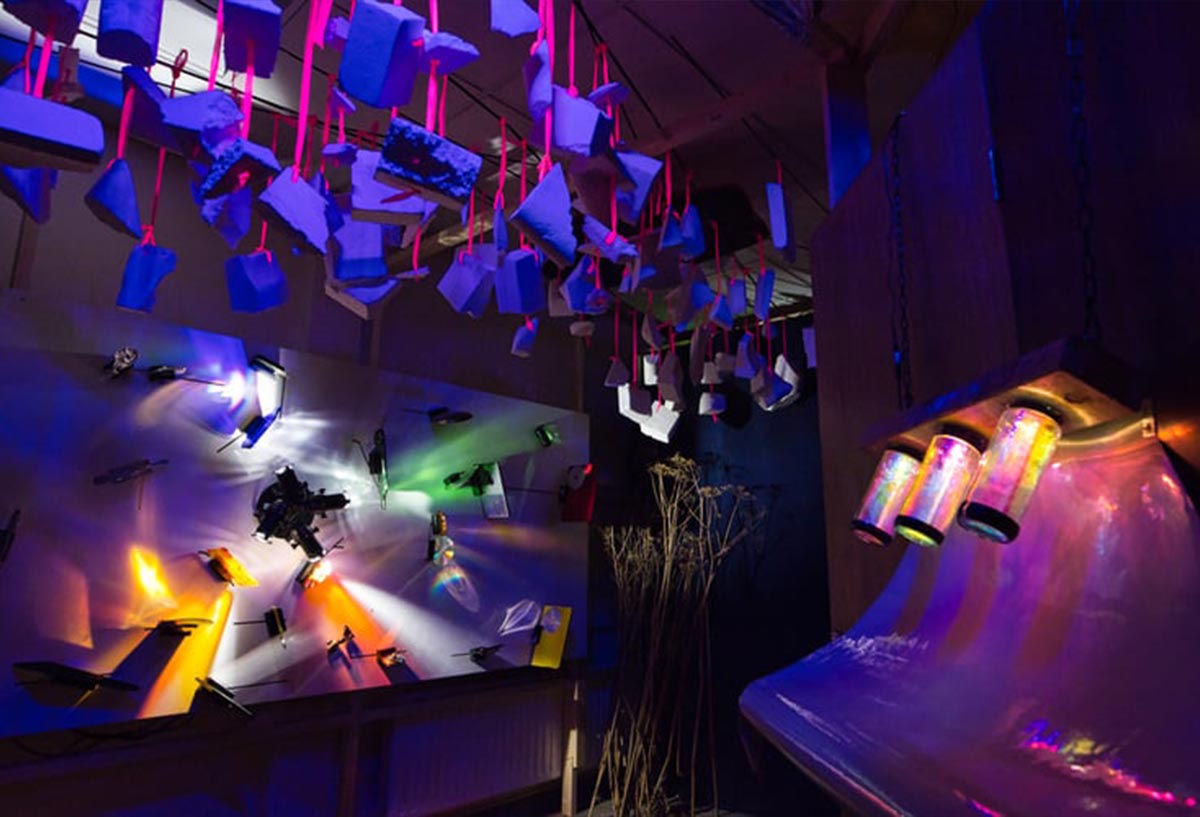
Working in sculpture, installation and participatory projects, Alice Mahoney’s work often transforms everyday materials into playful yet thought-provoking assemblages that explore care, repair and transformation. Alice is interested in how objects hold memory and emotion, and how making can build connection and resilience. Alice will create an immersive installation combining light, sound, sculpture and film, inspired by Bodmin’s watery past, present and future. Beginning with participatory walks to sites such as wells, rivers and caverns, with Alice and Jonny Davey, the project gathers stories, sounds and imagery to create an audio map, sculptural works by Alice Mahoney and film by artist Naomi Frears, that move water in playful, unpredictable ways.
Rebecca Proctor’s work combines traditional craft with contemporary forms. Using hand-built and thrown methods, she explores the meeting point between utility and imagination, often drawing inspiration from natural processes, geology and coastal landscapes. Her pieces balance fragility and strength, celebrating clay’s tactile qualities and its connection to place. Widely recognised in the contemporary ceramic world, the Flamm project will see Rebecca realising her largest sculpture and first outdoor piece. Rebecca’s project responds to the legend of Rose Wright, a 19th-century Bodmin Jail inmate said to have cursed the prison. Inspired by the jackdaws she befriended, the work features around 20 black ceramic birds swirling above a charred wooden plinth that evokes the jail’s weight and history.
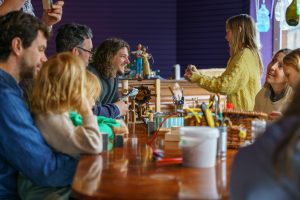 Colombian-born artist Carlos Zapata is known for his expressive carved wood sculptures and automata. Drawing on folk art traditions, personal history and global politics, his work tells stories of resilience, displacement and human emotion with bold colour and intricate detail. Often both playful and unsettling, his sculptures invite reflection on cultural identity, memory and the shared experiences that connect people across borders. For Flamm 2026, Carlos will present a large-scale sculptural automaton that transforms the familiar into the unexpected at Discovering 42.
Small Acts, led by Katie Etheridge and Simon Persighetti, create participatory artworks that bring communities together in inventive, joyful ways, often in the informal “third spaces” where people naturally gather. Visual artist Kitty Hillier works with biomorphic forms, layered abstraction and research into communication and plant intelligence. Together, they present Re:Rooted, a moving sculpture developed with young dancers from KBSK. Shaped by GPS mapping and creative walking, the root‑like form is carried through Bodmin, inviting audiences to navigate the town anew and discover hidden dances along the route.
Multidisciplinary artist Georgia Gendall works across sculpture, performance, writing, photography and participatory practice, often embracing absurdity, risk and unconventional materials. Her projects challenge ecological entanglements, interspecies relationships and the systems we inhabit, from worm‑charming championships to cow‑licked sculptures. For Change Here, Gendall transforms the Bodmin Railway announcement system into an uncanny conversation between two conductors. Loosely inspired by Cornwall Railway Society accounts and structured around thermodynamic cycles, the work drifts through themes of loss, nostalgia and change.
SHARP is a queer, working‑class, socially engaged artist whose interdisciplinary practice spans experimental video, photography, sculpture and sound installation. Their work explores remembrance, collective experience and queer perspectives on the human condition, with pieces held in major public collections and recent recognition from the Henry Moore Foundation and Exeter Contemporary Art Prize. Once We Were Held draws on research into Bodmin’s Bethany Project, a radical place of rest for people with HIV/AIDS. Combining sound, scent, visuals and sculpture, the installation creates a space of queer resilience, using reclaimed daffodils to connect LGBTQIA+ care histories with Cornwall’s landscape.
As well as co-commissioning SHARP’s project, the Flamm and Counterpoints Arts partnership has enabled an artist’s exchange project – putting the theme of the festival [Dis]Location in a wider context. Facilitated by artist Sovay Berriman, one of the co-commissioned artists in 2023, three Flamm artists are paired with three Counterpoints artists. Each pair exchanges on their socially engaged work, ideas and interests through a series of conversations in the run up to Flamm 2026. These exchanges will be documented and shared online, and the group will come together for a special episode in Sovay’s Meskla Podcast post-Festival.
The artist pairs are:
Flamm also holding a live podcast event during the festival to highlight the conversations around [Dis]Location, with Sovay Berriman & Liverpool Biennial 2025 Curator Marie-Anne McQuay, hosted by Jelena Sofronijevic of EMPIRE LINES podcast.
A collaboration with Liverpool Biennial will also bring several works from their 2025 event to Cornwall. The five selected commissions will be shown with two new commissions from Liverpool Biennial 2025: BEDROCK at Flamm 2026 by artists Linda Lamignan and Amber Akaunu:
Dear Othermother is a new film which tells a personal tale of single motherhood in Toxteth, Liverpool, by BAFTA Scholar and filmmaker Amber Akaunu. This autobiographical documentary-style film is inspired by the African proverb “it takes a village to raise a child”, and centres around single parents and their best friends who have built alternative ‘villages’ through which they collectively raise their children. Touched by the trees in a forest of eyes is a new multi-screen video work by Norwegian video and sound artist Linda Lamignan. Referencing the artist’s ancestry, the knowledge systems of animism and geology, Lamignan explores how the idea of land as a resource has been perpetuated throughout time by tracing the history of the palm oil and petroleum trade between Nigeria and Liverpool.
The festival programme is further enhanced by a wider programme of exhibitions, workshops and events led by artists and local communities.
This includes
Group exhibitions include Dialogues II with Heather Burwell, Tina Kutter, Jane Jobling, Sarah Bennett, Charlotte Squire, Chris Summerfield, John Elliott, Sara Bor, Keith Frake, Claire Gladstone, Stella Tripp at Discovering 42 and one by CAMP where the exhibition brings together 11 artists who recently connected through CAMP’s Sculpture and 3D KIN network, each with a longstanding engagement in sculptural materials and processes, and with space and/or site. Dialogues II refers to the exchanges and emerging shared themes that developed as the artists came to know one another and their respective practices. Contemporary Art Membership Platform (CAMP Membership CIC) is a member-led support and professional development network for artists, arts workers, and other creatives in the South West.
An exhibition bringing together two artists exploring what it means to be human through distinct yet overlapping perspectives. Through painting, Max Whetter approaches the subject from a male viewpoint, while Emma Digerud-White responds from a female perspective shaped by lived experience, care and emotional intimacy. Positioned within Flamm’s theme of [Dis]Location, the works consider emotional, psychological and relational states of belonging and estrangement, creating a dialogue that invites reflection on vulnerability, identity, connection and shared human experience.
Outdoor installations will pop up across the town: In the town square, with Jacqui Orly, visitors are invited to take part in a transaction. Penny for penny, pound for pound, money is exchanged for the exact same monetary value. A participant may hand over 50p and receive 50p in return, or exchange a £5 note for an equivalent amount made up of smaller denominations. There is no profit, no loss, and no apparent gain.
 Elizabeth-Jane Grose presents a multi-faceted installation in St Petroc’s Soldiers’ Chapel, examining the experience of [Dis]Location through the stories of people who experienced war. Using craft-based techniques and materials, Grose creates evocative images from stuff of the lower ranks of the art world, challenging notions of a visual hierarchy.
Elsewhere, Woven voices: The Bodmin Dress Project is a collaborative textile artwork created by local artist Rebecca Wood with the Bodmin community. Through shared stories, memories, and handmade contributions, the dress reflects personal and collective transformation, celebrating Bodmin’s past, present, and creative spirit. It will be in the town’s Air Ambulance shop and will include performances. Another textile work will be by Hannah Jacobs and participants at Kinsman Estate. A Tapestry for tickets to anywhere is a collective artwork initiated by Hannah Jacob with over 100 contributors all over Cornwall, now including additions from the residents at the Kinsman and Treningle Estate. Over the last few weeks, Hannah and the residents have used collage, movement and drawing to explore how public transport affects our lives and our connection to each other, and document the interesting and significant journeys in their lives.
Work by the community and with them is also seen in Alexander Prynne’s HERE, an immersive installation piece that explores and evokes neurodivergent safe spaces and experiences. It has been created by an autistic artist in collaboration with the local neurodivergent community for an authentic experience. Alexander Prynne is an autistic creative based in Bodmin. He creates work across a range of mediums including theatre, poetry and film.
Meanwhile, Amanda Young and SkillSHARE participants’ piece is a fun, interactive installation in the form of a walk-in book dedicated to the life stories of SkillSHARE’s participants, offering visitors the opportunity to engage with the storytelling aspect of the project and to explore their own narratives as a result. The Storybook of Bodmin aims to see people come out of the shadows to recognise and discover their own significance through its pages, thus exploring their own mental and physical health and aspirations, and the place of Bodmin within this.
Bodmin sits at the heart of Cornwall, where rich history, creative culture and vast natural landscapes meet. In its lively and wide-ranging spaces – ancient streets, moorland, woodland, communities, and country estates – it is a place that rewards those who dig a little deeper. It’s a place where discoveries are made. 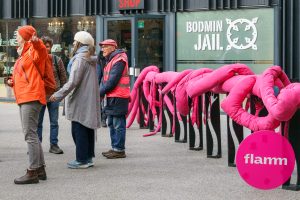
In addition to the festival, art lovers can also explore visitor attractions such as Bodmin Jail, Bodmin Railway or St Petroc’s Church, where history is at their fingertips. Bodmin is also a natural playground, where moorland gateways, rolling countryside, the Camel Trail and lush woodlands invite discovery at every turn. Visit Bodmin Moor, the rolling estate at National Trust’s Lanhydrock or take a stroll in Cardinham Woods.
Music, comedy, dance and cinema come together in glorious technicolour in the town. Organisations like intoBodmin, The Beat and St Petroc’s Church throw their doors wide to creative events and performances, and with a wealth of natural inspiration, Bodmin is also home to a hive-like community of creatives.
Get up close with their work at one of the local galleries – you’ll find them tucked in streets and studios around the town. In Bodmin, you’ll find workshops in everything from art and crafts at the Bodmin Gallery & Creative Studio, to sustainability and science at Discovering42.